S&P500 Daily Action Areas & Price Targets 20/7/26

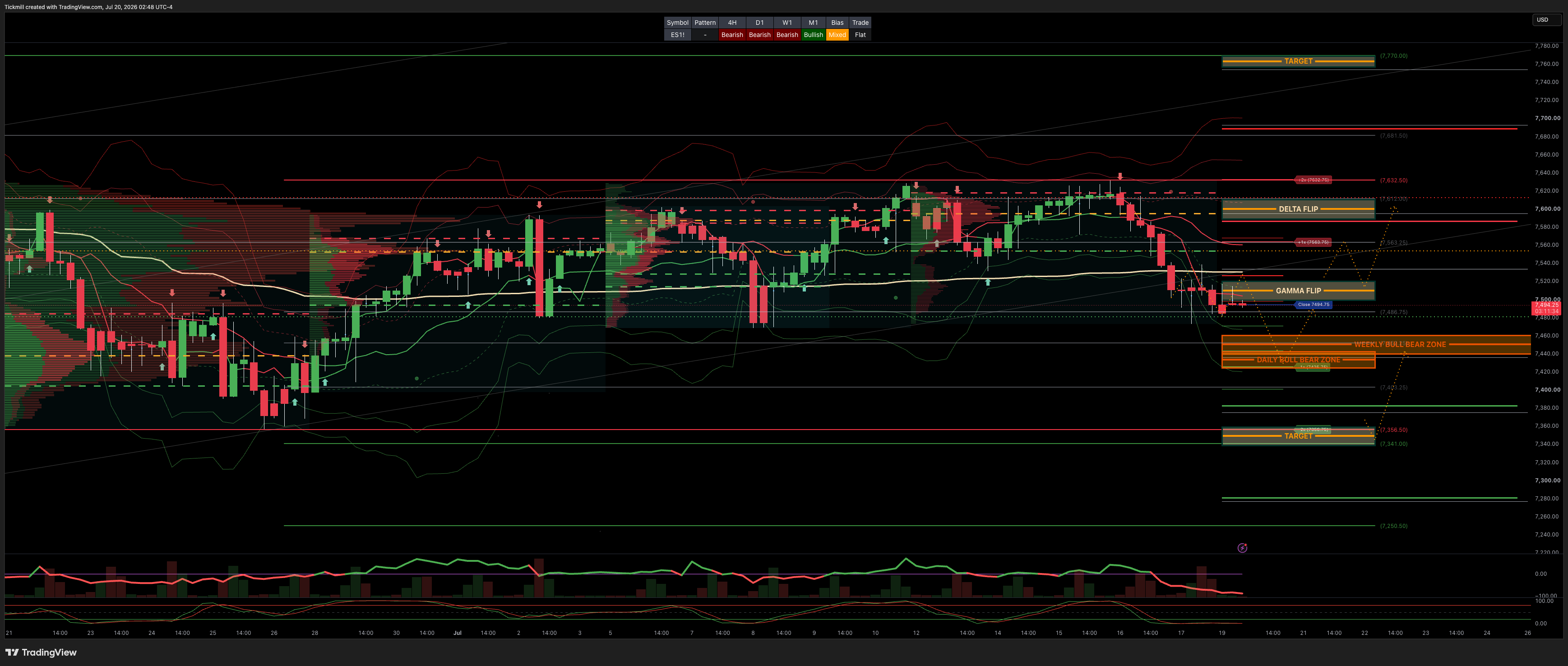
S&P500 Daily Action Areas & Price Targets 20/7/26
***QUOTING ES1! FOR CASH US500 EQUIVALENT LEVELS, SUBTRACT POINT DIFFERENCE***
WEEKLY BULL BEAR ZONE 7460/40
WEEKLY RANGE RES 7632 SUP 7358
MONTHLY RANGE RES 7838 SUP 7258
JHEQX Q3 Collar Short Call Cap: ~7,750 – 7,900 - Long Put Strike: ~7,050 – 7,100 (approx. 5% downside protection) Short Put Strike: ~5,950
DEC2025 OPEX to DEC2026 OPEX is 945 points giving us a range of [5889,7779]
SPX PUT/CALL RATIO 1.19 (The numbers reflect options traded during the current session.) A put-call ratio below 0.7 is generally considered bullish, and a put-call ratio above 1.0 is generally considered bearish.
GS Flow Desk: large S&P 31Aug 7000/7950 strangle in roughly $20mm vega / $115mm premium …My Read – classic “big convexity versus carry” trade: either someone paid a lot to own a wide August move, or someone got paid a lot to bet that the S&P stays comfortably inside the 7000–7950 corridor
DAILY VWAP BEARISH 7569
WEEKLY VWAP BEARISH 7563
MONTHLY VWAP BULLISH 7036
DAILY STRUCTURE - BALANCE 7627/7469
WEEKLY STRUCTURE - BALANCE 7648/7247
MONTHLY STRUCTURE - OTFH - 7247
Balance: This refers to a market condition where prices move within a defined range, reflecting uncertainty as participants await further market-generated information. Our approach to balance includes favouring fade trades at the range extremes (highs/lows) while preparing for potential breakout scenarios if the balance shifts.
One-Time Framing Higher (OTFH): This represents a market trend where each successive bar forms a higher low, signalling a strong and consistent upward movement.
One-Time Framing Lower (OTFL): This describes a market trend where each successive bar forms a lower high, indicating a pronounced and steady downward movement.
DAILY BULL BEAR ZONE 7430/40
GAMMA FLIP 7510
DELTA FLIP 7600
DAILY RANGE RES 7563 SUP 7425
2 SIGMA RES 7632 SUP 7356
VIX BULL BEAR ZONE 17.4
TRADES & TARGETS
LONG ON REJECT/RECLAIM DAILY BULL/BEAR ZONE TARGET RTH CLOSE
LONG ON REJECT/RECLAIM WEEKLY BULL/BEAR ZONE TARGET RTH CLOSE
***ADDITIONAL SETUPS & TARGETS HIGHLIGHTED ON THE CHARTS***
(I FADE TESTS OF 2 SIGMA LEVELS ESPECIALLY INTO THE FINAL HOUR OF THE NY CASH SESSION AS 90% OF THE TIME WHEN TESTED THE MARKET WILL CLOSE ABOVE OR BELOW THESE LEVELS)
GOLDMAN SACHS FICC & EQUITIES TRADING DESK VIEWS
US Equities — Weekly Wrap: Momentum Capitulation, Broadening Underneath
The week was defined by a deepening AI/semiconductor/momentum unwind set against a resilient broader market. Asset managers and hedge funds finished as small net buyers overall, but the more important signal was the composition of activity: high-touch levels are finally picking up, driven by a combination of hedge fund de-grossing, mutual fund reshuffling, and rising performance frustration. The last 48–72 hours saw a material uptick in angst around the sustained pullback in AI and semis, which is exactly the kind of behavior that tends to accompany the later stages of a factor unwind.
The key strategic call remains that we are in the later innings of the momentum unwind, based on three factors: the magnitude of the move relative to history on both absolute and vol-adjusted bases; cleaner positioning, with momentum exposure on the PB book now at the 77th percentile over one year (though still the 95th percentile over five years); and the absence of a clear fundamental catalyst, even as AI capex concerns weigh on the complex. The caveat is important: elevated five-year positioning means a deeper drawdown is still possible if capex disappoints or the AI narrative deteriorates structurally.
Prime Brokerage — Signs of Capitulation in Tech
The PB data confirm the stress. US equities were net sold this week, driven by short-and-long sales in single stocks. Macro products were slightly net bought via risk unwinds, with short covers outpacing long sales. Most importantly, Info Tech was the worst-performing and by far the most net-sold US sector, with long-and-short sales in roughly equal notional.
That combination matters. The persistence and magnitude of selling since early June point to significant length reduction by tech investors, and the desk notes that some signs of capitulation are starting to emerge. Capitulation is typically what marks the end of a positioning-driven unwind, which supports the "later innings" thesis.
Risk exposure data reinforce how far de-risking has gone:
Metric | Latest | Change | Percentile (1Y) |
|---|---|---|---|
US L/S Gross leverage | 204.9% | +1.0 pts | 6th percentile |
US L/S Net leverage | 51.2% | -0.4 pts | 11th percentile |
Both gross and net leverage sitting near the bottom of their one-year ranges is a powerful signal. Hedge funds have de-risked aggressively. That reduces the risk of further forced selling and creates the raw material for a bounce if earnings provide a positive catalyst. It is a classic setup where cleaner positioning meets a high-stakes earnings test.
The Week Ahead — Hyperscaler Capex Is the Main Event
Next week is pivotal, with roughly 18% of S&P 500 market cap reporting. The single most important theme is hyperscaler capex, with GOOG/GOOGL and TSLA on Wednesday the marquee events. This is the crux of the entire AI debate right now: the semiconductor complex has been punished on capex and expectations concerns, so the market needs the hyperscalers to re-underwrite the AI trade.
The bull case, as the TMT desk frames it, needs three things from the hyperscalers: large cloud revenue growth, strong margins, and big backlogs. If GOOG delivers on those fronts, it would help stabilize sentiment across the AI complex and validate the case that the semi selloff was a positioning washout rather than a fundamental break. All eyes are on GOOG Wednesday, with AMD's Advancing AI Event (July 22–23) an additional catalyst.
The broader industrials and defense complex also reports in force, with LMT, RTX, HON, and UNP on Thursday. US macro data is light, and the FOMC enters blackout Saturday ahead of the 7/29 rate decision. Overseas, the ECB decision (Thursday) and Burnham's installation as UK PM (Monday) are on watch.
Sector Mark-to-Market
TMT — Exhausting Week, but Software Divergence Is Telling
An exhausting and frustrating week for TMT, with the NDX reversing down roughly 350bps alongside the worst week of SOX performance since April 2025. What began as a "healthy pullback" in late June has morphed into something that is testing investor patience, with SOX now underperforming the market by around 20 points since the late-June highs.
The most important dynamic is the divergence within tech. While semis broke down, leading security and data infrastructure software names were robust: CRWD +9% and PANW +10%. Bulls argue these names are well positioned to benefit from GenAI and inference over the coming years while carrying less convexity to semiconductor bottlenecks, tightness, or model leaderboard dynamics. This is the same rotation theme we have been tracking: capital is moving from crowded, capex-sensitive hardware toward software beneficiaries of AI adoption. The market now needs earnings, ideally from GOOG, to re-underwrite the broader AI trade.
Industrials — Broadening Beneficiary, but Fuel Costs Bite
Industrials fell about 130bps, slightly underperforming the broader market. Materials were closer to flat as Middle East escalation fears and rising crude helped the group. Builders and transports outperformed on positive short-cycle data points and slightly lower rates.
Earnings were mixed but instructive. FAST fell on mixed margins despite strong 15% June topline growth. UAL offered upbeat commentary but guided below consensus due to higher jet fuel costs, a direct read-through from the oil spike. GE delivered a well-anticipated beat and raise but fell 5% on aftermarket growth and valuation concerns. ALV fell 4% after lowering its light vehicle production forecast. Next week brings DHI (housing), GM (autos), MMM (manufacturing), CSX (transports), and GEV (power).
Energy — Refining Leads, Solid 2Q Ahead
Energy debate remains elevated, with refining (VLO, MPC, PBF, DK) outperforming on tight product markets, higher cracks, and low inventories. 2Q EPS is expected to be extremely solid, with a bullish 3Q setup and strong buyback support. Interestingly, the desk is seeing more interest in European majors (SHEL, BP, REP) than US majors (XOM, CVX), though most are long CVX into a solid 2Q print. Oilfield services (SLB, WFRD) have lost momentum on moderated activity expectations and Strait of Hormuz-related sentiment.
Financials — Constructive Start, Quality Differentiation
Financials kicked off constructively. Bank earnings featured large fee-driven beats from investment banking, equities trading, and wealth management, and importantly the stocks largely cleared the bar of proving 2Q strength is sustainable into 2H. The largest moves were at names with margin or operating-leverage stories: C underperformed on a potential shift in its multi-year efficiency story, while BLK saw strong top-line flow through to its highest margin in five years.
Broader read-throughs were positive: constructive Alts commentary (credit performance, retail demand), accelerating consumer spend at the banks (implying top-line beats for card networks), and clean credit quality. In insurance, TRV again demonstrated strong underwriting despite decelerating pricing. Next week shifts focus to Alts (BX), card lenders (COF, SYF, AXP), wealth/retail brokers (AMP, IBKR, RJF), insurance brokers (MMC), and datacenter REITs (DLR) — with DLR notable as a name caught up in the momentum pullback that has lost its YTD relative outperformance.
Synthesis — Positioning Is Clean, Now Earnings Must Deliver
The week crystallized a clear setup. On one side, the momentum/AI/semi unwind has been violent and persistent, with signs of capitulation, bottom-decile net and gross leverage, and rising investor frustration. On the other side, the broader market has been remarkably resilient, with software, healthcare, industrials, financials, and equal-weight all providing offset.
This is a market where positioning risk has been largely wrung out of the crowded AI trade but where the fundamental verdict is still pending. The setup into next week is therefore unusually binary around hyperscaler capex:
If GOOG (and the hyperscalers) deliver strong cloud revenue, margins, and backlogs, the cleaner positioning becomes fuel for a sharp relief rally in the beaten-down AI/semi complex. Bottom-decile leverage plus capitulation plus a fundamental catalyst is a classic squeeze setup.
If hyperscaler capex disappoints or guidance signals discipline/digestion, the still-elevated five-year momentum positioning leaves room for a deeper, more structural drawdown in the AI trade.
Trading Implications
Stay constructive but hedged into hyperscaler earnings. Positioning is clean enough to support a bounce, but Wednesday's GOOG print is the key swing factor.
Lean into the broadening. Software (security/data infra), medtech, industrials, financials, and other lightly positioned areas remain the cleaner way to stay invested while the AI complex resolves.
Selectively re-engage washed-out semis/AI given capitulation signals and bottom-decile leverage, but size for the two-way risk around capex.
Watch DLR and datacenter REITs as a mean-reversion candidate that has been unfairly caught in the momentum unwind.
Own index and QQQ optionality through the catalyst-heavy week, with skew still the preferred expression given the binary capex risk.
Respect the oil read-through to consumer and transport margins (UAL's fuel-driven guide is the template).
Disclaimer: The material provided is for information purposes only and should not be considered as investment advice. The views, information, or opinions expressed in the text belong solely to the author, and not to the author’s employer, organization, committee or other group or individual or company.
Past performance is not indicative of future results.
High Risk Warning: CFDs are complex instruments and come with a high risk of losing money rapidly due to leverage. 69% and 73% of retail investor accounts lose money when trading CFDs with Tickmill UK Ltd and Tickmill Europe Ltd respectively. You should consider whether you understand how CFDs work and whether you can afford to take the high risk of losing your money.
Futures and Options: Trading futures and options on margin carries a high degree of risk and may result in losses exceeding your initial investment. These products are not suitable for all investors. Ensure you fully understand the risks and take appropriate care to manage your risk.
Patrick has been involved in the financial markets for well over a decade as a self-educated professional trader and money manager. Flitting between the roles of market commentator, analyst and mentor, Patrick has improved the technical skills and psychological stance of literally hundreds of traders – coaching them to become savvy market operators!